A practical guide for businesses weighing an integrator and for AV and IT providers adding digital signage to their offering.
Key takeaways
Full-service deployment partners: digital signage integrators design, install, configure and support complete signage systems, covering hardware, software, network and content
Integrator vs operator: integrators are project-based deployment specialists, while operators sell signage as an ongoing managed service, and the engagement model differs accordingly
Not every project needs one: cloud-based CMS platforms have made small and mid-size deployments self-serve, so integrators earn their fee on multi-site, custom-hardware or compliance-heavy projects
Vetting is about fit, not size: sector track record, platform partnerships, service-level commitments and post-install support matter more than headcount
For providers, signage is a recurring revenue lane: the industry is moving from one-time installs to managed services, and the platform you standardize on decides your margin
A digital signage project looks simple on a slide: screens, players, content, done. Then the questions start. Which displays survive a storefront window? Who runs cabling through a finished ceiling? What happens when a screen in another state goes dark on a Saturday?
Digital signage integrators exist to answer those questions for you, and for the right project they are worth every dollar. For the wrong project, they are an expense you never needed. This guide covers both sides of that line, for businesses deciding whether to hire an integrator and for AV and IT providers deciding whether to become one.
What is a digital signage integrator?
A digital signage integrator is a company that designs, installs, configures and supports complete digital signage systems, combining displays, media players, software, network infrastructure and content into one working deployment. Instead of buying screens from one vendor, software from another and installation from a third, you get an integrator taking single-point responsibility for making every component work together.
The term overlaps with several others you will see in the market. An AV integrator or display integrator handles digital signage as one part of a wider audiovisual practice that might also cover conference rooms, video walls and sound systems. A digital signage system integrator specializes in signage networks specifically. In practice the labels blur, and what matters is not what a firm calls itself but which parts of a deployment the firm can own.
This article explains what digital signage integrators actually deliver, how integrators differ from digital signage operators, when hiring one makes sense and when it does not, how to vet candidates, and, for AV and IT providers reading from the other side of the table, how to build digital signage into a service offering with recurring revenue behind it.
What does a digital signage integrator do?
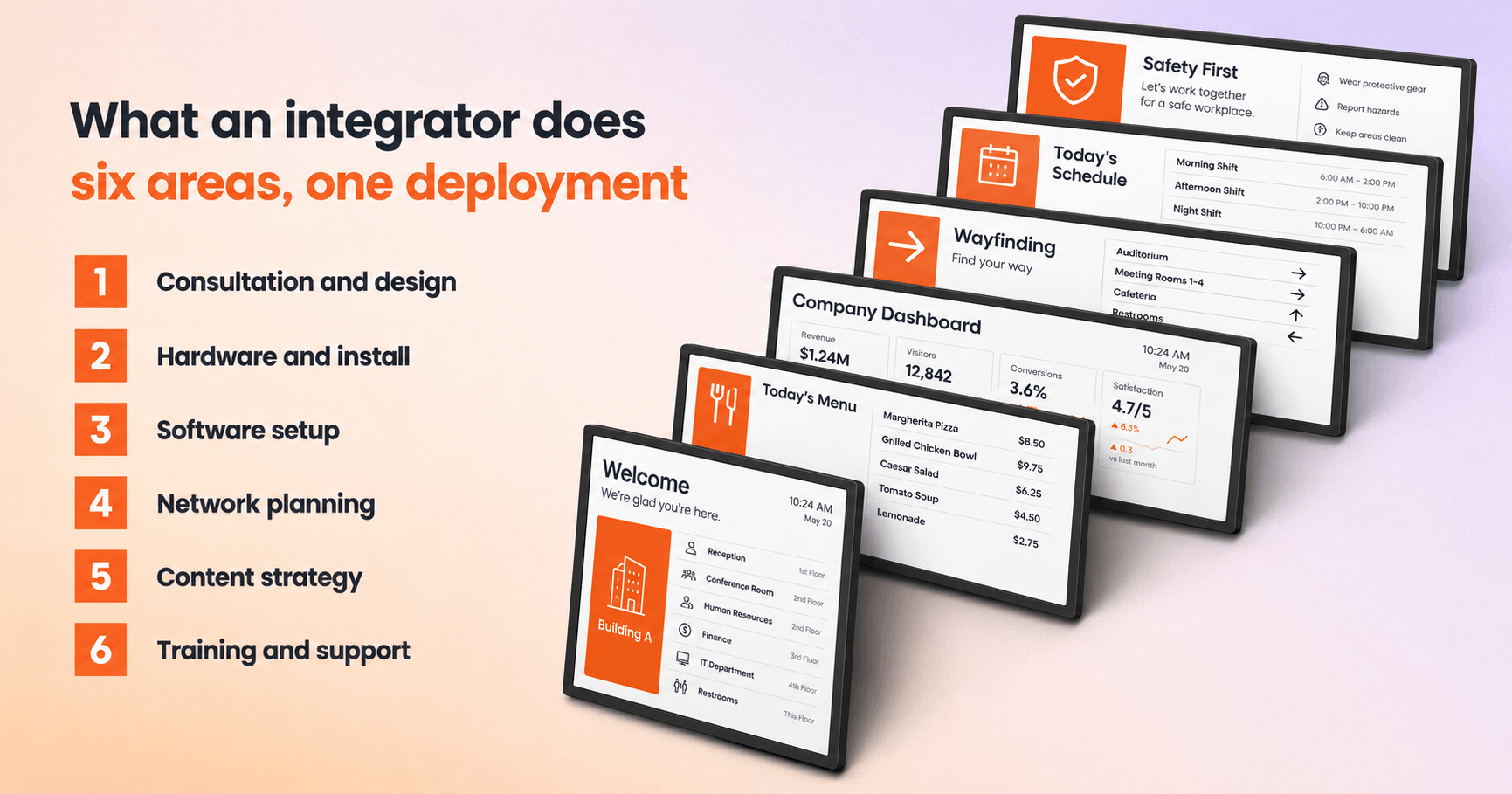
A digital signage integrator manages the full lifecycle of a signage deployment, from the first scoping conversation to the support call three years after launch. The work breaks down into six areas.
Consultation and system design come first. The integrator starts with your goals, locations, audience and budget, then translates them into a specification: how many screens, where they go, what content they run and what the whole system costs to own over its life.
Hardware selection and installation follow. Commercial displays differ enormously in brightness, duty cycle and warranty terms, and the same is true of digital signage media players. Integrators match hardware to the environment, then handle mounting, cabling, power and physical installation, including the certified work that storefront glass, ceilings and outdoor enclosures require.
Software configuration is where the system takes shape. The integrator sets up the content management system, builds the screen structure, configures user roles and connects any data sources you need on screen, such as menus, dashboards or calendars. If you are unsure what sits between the screen and the software, this explainer on what is a digital signage player covers the middle layer.
Network and infrastructure planning carries the multi-site work. Deployments across many locations live or die on connectivity, so integrators plan bandwidth, VLANs, firewall rules and offline behavior so a store’s screens keep playing when the internet drops.
Content strategy rounds out the launch. Many integrators offer content design, templates and scheduling strategy, either as a launch package or an ongoing service.
Training and support close the loop. After go-live, the integrator trains your team on day-to-day content management and provides tiered support, from remote troubleshooting to on-site hardware replacement.
Integration services come as a complete package or as individual line items. A business with a capable IT team often hires an integrator only for physical installation, while a marketing-led organization might outsource everything except the content calendar.
Integrator vs operator: what’s the difference?
A digital signage integrator deploys your system as a project; a digital signage operator runs your system for you as a service. The two roles get lumped together constantly, but the business relationship you enter is different in almost every way.
An integrator’s engagement is deal-based. The integrator designs and installs the system, hands you the keys, and steps back into a support role. You own the deployment, hold the software subscription and manage the content.
An operator, sometimes called a managed service provider, builds its business on the ongoing relationship. Operators bundle software, monitoring, content management and support into a monthly fee, and often deliver the whole service under their own brand. You never touch the CMS unless you want to.
| Integrator | Operator | |
|---|---|---|
| Business model | Project-based deployment | Ongoing managed service |
| Relationship | Short-term, ends at handover plus support | Long-term, contract-based |
| Who manages content | You | They do |
| Software subscription | Yours | Theirs, often white-labeled |
| Revenue model | One-time project fee | Recurring monthly fee |
| Best for | Teams that want ownership and control | Teams that want signage off their plate |
Interesting insight: The confusion between the two terms is partly the industry’s own fault. Many firms do both, operating as an integrator on one contract and an operator on the next. The question to ask a candidate is never “are you an integrator or an operator?” but “who manages the system after launch, and what does that cost per month?”
Neither model is better. The integrator model suits organizations that want to own their signage and keep per-screen costs low over time. The operator model suits organizations that would rather pay a predictable fee and never think about screens again. What you should avoid is paying operator-level ongoing fees for what was actually a one-time integration job.
When should a business hire a digital signage integrator?
Hire a digital signage integrator when the deployment carries physical, technical or regulatory complexity your team cannot absorb. The clearest signals:
you are deploying across many locations and need consistent installation quality without sending your own people to every site
the hardware is non-standard: video walls, outdoor displays, drive-thru menu boards, interactive kiosks or LED installations
the environment has compliance requirements, such as healthcare privacy rules, union labor requirements or landlord-mandated certified installers
screens must connect with building systems, POS infrastructure or restricted corporate networks that need professional network engineering
downtime is expensive, and you need contractual response times rather than best-effort troubleshooting
One more scenario belongs on the list: you simply do not have anyone whose job this can be. An integrator is cheaper than a mismanaged rollout.
When you don’t need one
For a standard deployment of off-the-shelf screens, modern cloud signage platforms have made integrators optional. A plug-and-play media player, a commercial display and a cloud CMS get a screen live in under an hour, with no network engineering and no site survey. If your project is a handful of screens per location running scheduled content, your own team can handle digital signage installation with a screwdriver and an afternoon.
The honest breakpoint sits around deployment complexity, not screen count. A single lobby video wall justifies an integrator. Fifty standard screens across ten offices, all running the same cloud CMS, usually does not. Integrator firms will rarely tell you this, which is exactly why the point belongs in your scoping conversation: ask a candidate “what part of this project could we do ourselves?” and judge the firm on the honesty of the answer.
How to choose a digital signage integrator
Choose a digital signage integrator on sector track record, platform expertise and post-launch support terms, in that order. Size and brand-name client lists matter far less than whether the firm has deployed in environments like yours.
Work through this checklist with every candidate:
Sector experience. A firm that has deployed 40 QSR menu board projects understands grease, heat and franchise approval workflows in a way a corporate AV specialist does not. Ask for references from your industry specifically
Platform partnerships. Integrators standardize on a small set of CMS platforms. Ask which ones, why, and whether you keep ownership of the software subscription after handover
Service-level commitments. Get response times, escalation paths and on-site repair terms in writing before you sign, and confirm what happens outside business hours
Scope honesty. A good integrator will tell you which parts of the project you can self-serve. Treat a firm that insists everything requires professional services as a red flag
Exit terms. Confirm you can change support providers later without losing access to your own system, content or accounts
How integrators charge
Integrators price in three patterns, and knowing which one you are in prevents most billing surprises. Project-based pricing quotes the full deployment as a fixed fee covering design, hardware, installation and configuration, with support sold separately. Managed service pricing rolls everything into a per-screen monthly fee, which shifts the engagement toward the operator model. Hybrid pricing, now the most common structure for mid-size deployments, combines a fixed installation fee with an optional monthly support retainer.
Whichever structure you are quoted, insist the software subscription is itemized separately from services. Bundled quotes routinely hide margin in the software line, and you should know what the CMS costs on its own. Our breakdown of digital signage costs covers what the underlying hardware and software actually cost, which gives you a baseline to negotiate against.
Where to find one
Searching for an integrator near you returns a wall of lookalike service pages, so start from curated lists instead. AVIXA, the audiovisual industry trade association, maintains member directories of certified AV firms. CMS vendors publish partner directories of integrators certified on their platform, which is the fastest route when you already know which software you want. Trade publications that cover the integration industry run vendor and project coverage that shows you who actually ships work in your sector.
For AV and IT providers: adding digital signage to your offering
For AV integrators, IT resellers and managed service providers, digital signage is one of the more accessible expansion lanes in commercial technology. According to AVIXA market research cited in Commercial Integrator, digital signage is expected to produce $41.4 billion in global revenue with a 5.7% compound annual growth rate from 2024 to 2029. For a provider already installing networks, screens or conference rooms, that growth sits directly adjacent to work you are already winning.
The strategic case is bigger than the market size. Signage deployments create natural recurring revenue: software subscriptions, content services, monitoring and support contracts that keep billing long after the installation invoice clears. Recurring revenue matters to your company’s valuation, not just its cash flow. Analysis of AV integration M&A by CT Acquisitions, drawing on Jahani & Associates transaction data, found that install-led integrators with under 10% recurring revenue trade at roughly 3 to 6 times EBITDA, while firms with 25% or more of revenue in fixed-fee managed services trade at 9 to 13 times. The same installation work, wrapped in a recurring service model, is worth more than twice as much to a buyer.
Digital signage is a practical way to build that recurring layer because the ongoing service load is light. Cloud CMS platforms handle updates, monitoring and content delivery centrally, so a small team can support hundreds of client screens without a truck roll.
The IT reseller Serit followed exactly this path, adding digital signage to its existing IT service portfolio with Yodeck as the platform layer and expanding the offering across its client base without building a signage-specific engineering team. Yodeck runs partner programs built for this motion: a digital signage reseller track with margin on subscriptions, and a broader Yodeck partner program spanning more than 1,000 partners serving 65,000+ customers in 135+ countries.
Start with your existing customer base. Every client site you already support has walls, lobbies and break rooms, and a provider who already holds the IT relationship is the default choice when those screens go digital.
What should integrators look for in a signage platform?
Integrators should evaluate a signage platform on multi-client management, remote device control, hardware flexibility, API depth and margin structure, because those five factors determine whether each new client adds profit or support burden.
Multi-client management comes first because you will run many customers from one operation. The platform needs clean separation between client workspaces, per-client user roles and a way to move between accounts without logging in and out. For providers who want the platform under their own brand, a white label digital signage option turns the CMS into your product rather than someone else’s.
Remote device management protects your margin, because truck rolls are where signage service profits die. The platform should let you check player status, restart devices, push updates and troubleshoot remotely across every client. Yodeck’s remote device management covers its Raspberry Pi-based players and extends to hardware like the Amazon Signage Stick, with remote power actions, playback checks and device health monitoring from the dashboard.
Pro tip by Yodeck Team: Set up offline email notifications per client, with the client’s own contacts in the loop. When a screen drops, the client hears about the outage from your monitoring before spotting it on the wall, which is the cheapest customer retention tool in the service business.
Hardware flexibility decides how many deals you can say yes to. Clients arrive with existing screens, mixed operating systems and strong opinions, and a platform that runs on Raspberry Pi, Android, Windows, webOS, Tizen and Fire TV hardware lets you take those deals without maintaining parallel systems.
API depth matters once provisioning becomes your bottleneck. The Yodeck API supports programmatic management of users, groups, roles and bulk screen operations, which means client onboarding can be scripted rather than clicked through.
Security and compliance close enterprise deals. Corporate clients will send security questionnaires, so standardize on a platform that answers them well. Yodeck is ISO 27001 certified and GDPR and CCPA compliant, with enterprise-grade security features covering encryption and access control.
Margin structure is the last check before you commit. Confirm reseller pricing, whether subscriptions bill through you or direct, and what happens to your cut as a client’s screen count grows. The platform’s list price matters less than the structure of your margin.
Independent review data is a reasonable proxy for how much support burden a platform will hand you. Yodeck holds a 4.7 out of 5 rating across 2,852 verified reviews on G2, with ease of use and easy setup as the two most-mentioned strengths. Less setup friction for end clients translates directly into fewer tickets for the provider in the middle.
If you want to evaluate the platform side hands-on before committing to a program, you can test a full deployment on a single screen for free with digital signage software that takes minutes to set up.
The bottom line
Digital signage integrators solve real problems: complex installations, multi-site consistency and accountable support. Hire one when your deployment carries that complexity, skip one when a cloud platform lets your own team do the job, and if you are a provider, treat signage as the recurring revenue lane the market data says it is.
Either way, the platform underneath decides how much of the work is hard. See how simple the software side can be, start with one screen for free.
Become a Yodeck partner
Join a network of 1,000+ partners on a platform trusted by 65,000+ customers in 135+ countries, and earn recurring revenue from every screen.
Become a partner