Everything agencies, MSPs and AV integrators need to know before putting their brand on someone else’s signage platform.
Key takeaways
White label digital signage software lets you sell a fully branded signage platform without building the technology yourself
White labeling differs from reselling in brand ownership, pricing control and who owns the customer relationship
Not all white labeling goes equally deep: some platforms swap a logo, others rebrand the domain, emails and support experience
Vendor selection comes down to seven criteria, including pricing transparency, hardware flexibility and exit terms
The commercial upside is recurring revenue you price and package yourself, bundled with the services you already sell
Your clients already ask you about screens. Whether you run an agency, an MSP or an AV integration business, digital signage keeps coming up in projects, and every time you refer it out, someone else books the recurring revenue. Building your own platform costs years and a development team you don’t have.
White label digital signage software solves that equation: you sell a signage platform under your own brand, and a vendor runs the technology behind it. This guide explains what white label digital signage is, how a partner program actually works, how it compares to reselling and what separates a real white label platform from a logo swap. By the end, you’ll know exactly what to ask a vendor before you sign.
What is white label digital signage?
White label digital signage is a ready-made signage platform that a vendor builds, hosts and maintains, and that you rebrand and sell as your own. Your clients see your logo, your colors and your domain. The vendor stays invisible, handling infrastructure, updates and security behind the scenes.
The model borrows from private-label retail. A supermarket’s store-brand cereal often comes off the same production line as the name brand, packaged differently. White label digital signage software applies the same logic to a content management system (CMS): the technology is proven, and the packaging is yours.
The distinction matters because the digital signage market keeps pulling more service businesses into it. Grand View Research values the global digital signage market at $31.1 billion in 2025, with a projected $58.4 billion by 2033. For an agency or integrator, that growth shows up as client demand you either capture under your own brand or hand to a competitor.
How does a white label digital signage program work?
A white label digital signage program works in three steps: the vendor gives you a rebranded instance of its platform, you create and manage client accounts through an admin layer, and you sell subscriptions at prices you set. The vendor bills you a partner rate per screen. You bill your clients whatever your market supports.
In practice, the day-to-day runs through a partner portal. From one dashboard, you create client accounts, assign screen licenses, set user roles and jump into a client’s environment when they need support. Your clients log into a platform that carries your name. When they need help, they call you, not the vendor.
The part most buyers miss is that white labeling is not one thing. Platforms rebrand to very different depths, and the difference decides whether your clients ever discover who really built the software. Broadly, white labeling comes in three levels:
| Level | What gets rebranded | Where the vendor still shows |
|---|---|---|
| Logo swap | Your logo and accent colors inside the dashboard | URLs, login page, email notifications, documentation |
| Interface rebrand | Full dashboard theming, custom login page, vendor name stripped from the interface | Domain and system emails |
| Full rebrand | Custom domain, branded email notifications, branded documentation and support experience | Nowhere visible to the client |
A logo swap looks like white labeling in the sales demo and falls apart the first time a client receives a system email from the vendor’s domain. If brand ownership is the reason you’re choosing this model, the level of rebranding is the first thing to pin down. We’ll come back to this in the evaluation criteria below.
White label vs. reseller: which partner model fits your business?
The difference between a white label partner and a reseller comes down to whose brand the client sees and who controls the price. A white label partner sells the platform as their own product at their own price. A reseller sells the vendor’s branded product, usually at a margin or commission the vendor structures.
That single difference cascades into everything else:
| White label partner | Reseller | |
|---|---|---|
| Brand the client sees | Yours, at every touchpoint | The vendor’s |
| Pricing control | You set the price and packaging | Vendor pricing or commission structures |
| Customer relationship | You own it, including support | Shared; clients can go direct to the vendor |
| Support burden | On you, with vendor backup | Mostly on the vendor |
| Upfront effort | Higher: onboarding, support processes, billing | Lower: sell and hand off |
| Best fit | Businesses with support capacity that want brand equity | Businesses testing signage as a side offering |
Neither model is the upgrade of the other. Reselling suits a business that wants signage revenue without absorbing support responsibility. Serit, a Norwegian IT reseller, took that route with Yodeck and expanded its service portfolio with digital signage while keeping its core IT business front and center. The reseller path let Serit add a new revenue line without rebuilding its support operation around a new product.
White labeling suits the opposite profile: a business that already handles client onboarding and support and wants every product interaction to build its own brand instead of a vendor’s. If your clients would happily rely on you for signage support the way they rely on you for managed IT or AV maintenance, reselling gives that brand equity away. The two models also aren’t mutually exclusive across a vendor’s program; many businesses start with a digital signage reseller program and move to white label once signage revenue justifies the operational lift.
Who needs white label digital signage?
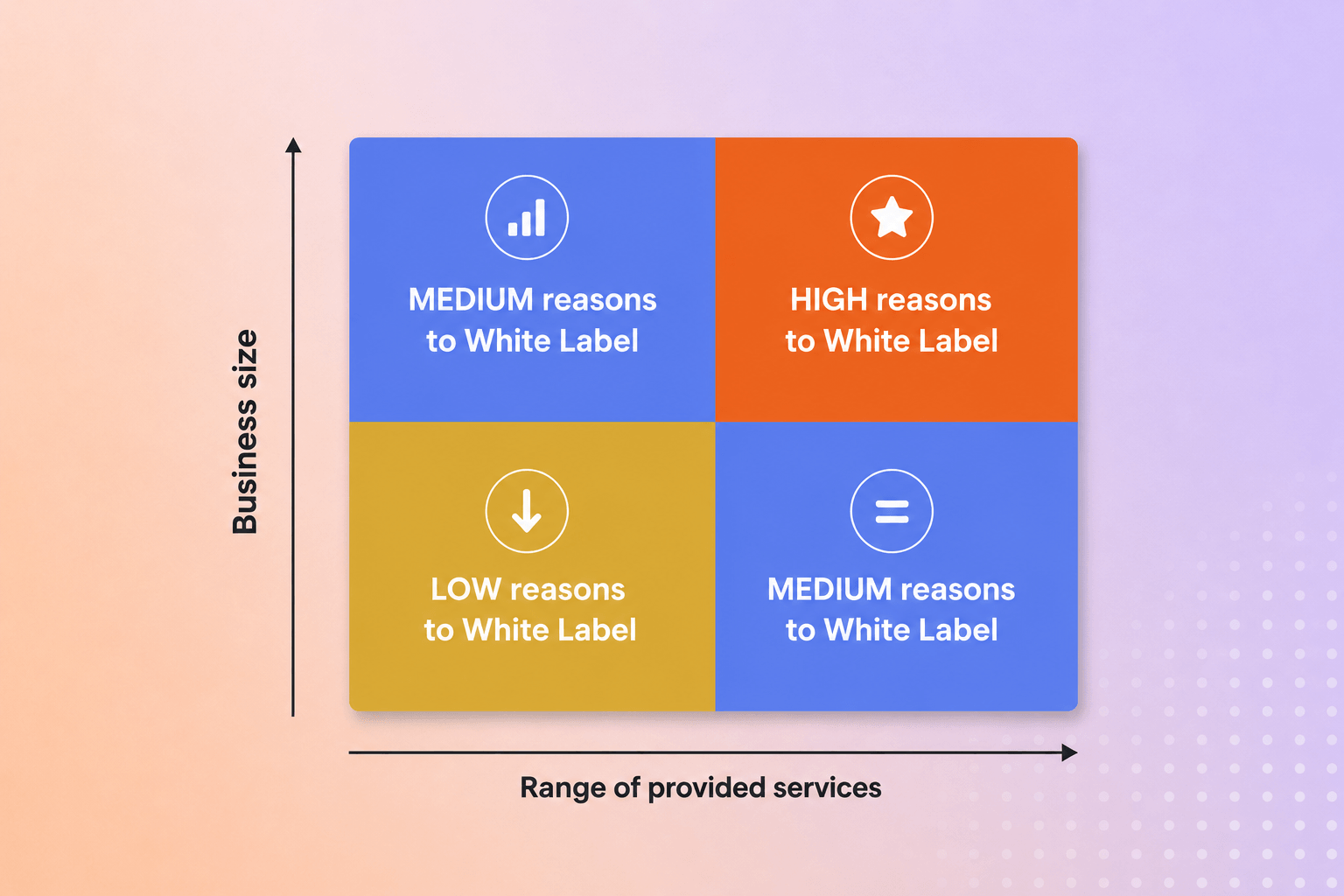
White label digital signage fits businesses that already sell recurring services to clients with physical locations: marketing agencies, managed service providers, AV and IT integrators, and franchises or enterprises standardizing screens across sites. The common thread is an existing client relationship that signage can deepen.
For agencies, screens are a media channel their clients already own but rarely use well. An agency that manages a retail client’s social and email campaigns can extend the same content strategy to in-store screens, billed under the agency’s own platform.
For MSPs, signage is a natural line item in a managed services contract. The economics of the MSP model reward exactly this kind of addition: CompTIA found that among channel companies offering managed services, 37% are pure-play MSPs earning more than three quarters of their revenue from recurring activities. Every screen under management is another node on the monthly invoice, and it runs on infrastructure the MSP already monitors.
For AV and IT integrators, white labeling closes the gap between installing screens and owning what runs on them. An integrator that mounts displays and walks away leaves the ongoing software revenue to someone else. An integrator with a branded CMS keeps billing long after the install crew leaves.
For franchises and multi-location enterprises, the white label question points inward rather than at clients: a branded platform gives head office a tool that looks and feels like internal software, which helps adoption across hundreds of locations.
What to look for in white label digital signage software
Seven criteria separate a white label platform you can build a business on from one that will embarrass you in front of clients: depth of branding, multi-tenant administration, pricing transparency, hardware flexibility, security and compliance, support model, and contract and exit terms. Most vendor comparisons cover the first two and skip the last five. The last five are where partnerships go wrong.
Depth of branding
Ask the vendor to show you every client-facing surface: the login URL, the dashboard, system emails, password-reset flows, help documentation and the player boot screen. Then ask which of those carry your brand and which still carry theirs. The three-level framework above gives you the vocabulary; a vendor offering a logo swap should not be priced or pitched like a full rebrand.
Multi-tenant administration
Your admin portal is where you’ll spend your working hours, so test it like an operator. You should be able to create a client account in minutes, assign and reclaim screen licenses without a support ticket, isolate each client’s content and users from every other client’s, and access a client environment for troubleshooting. If you plan to grow past a handful of clients, check for an API: programmatic control over users, roles and bulk screen operations is the difference between onboarding a 50-site client in an afternoon and in a week.
Pro tip by Yodeck Team: If you manage large rollouts, look for API support covering users, groups, roles and bulk screen actions. Yodeck’s API lets partners script account setup and screen provisioning instead of clicking through hundreds of screens one at a time.
Pricing transparency
Pricing is the loudest complaint in peer discussions among signage partners, and it usually takes the same shape: the per-screen rate looked clean until the invoice arrived with platform fees, feature unlock charges or minimum commitments nobody mentioned on the sales call. Get the full cost model in writing: the partner rate per screen, any monthly platform or account fees, which features cost extra and what volume the discounts actually require. You are building a margin business; an opaque cost base makes your own pricing guesswork.
Hardware flexibility
A white label platform that only runs on the vendor’s proprietary player quietly locks your hardware margin and your client’s capital budget to one supplier. Check which operating systems and devices the platform supports, whether you can source players independently and what happens to existing screens a client already owns. The wider the device compatibility, the more installed hardware you can take over rather than replace, which often decides whether you win a migration deal at all.
Security and compliance
Your brand is on the platform, so your reputation absorbs every incident. Ask for the vendor’s certifications (ISO 27001 is the baseline worth expecting), encryption standards and GDPR or CCPA posture. Enterprise clients will send you their security questionnaires; you want a vendor whose answers you can forward instead of rewrite.
Support model
White labeling means your clients call you first, but you need to know what stands behind you. Clarify response-time commitments for partners, escalation paths for platform-level issues and whether the vendor offers priority queues for partner tickets. A vendor that treats partners like ordinary end users becomes your bottleneck at the worst possible moments.
Contract and exit terms
Nobody signs a partnership planning to leave it, which is exactly why exit terms get skipped and exactly why they shouldn’t be. Before signing, get answers in writing: What happens to your client accounts and their content if you switch platforms? Are there minimum terms or termination penalties? Can the vendor contact your clients directly, during the partnership or after it ends? Who owns the client relationship data? Lock-in worries dominate partner discussions for a reason. A confident vendor will answer these questions without flinching; hesitation here tells you more than any feature demo.
How to price and package a white label signage offer
Pricing a white label signage offer starts from a simple structure: the vendor charges you a partner rate per screen per month, and you charge your clients a rate that covers the license, your services and your margin. Because you set the client-facing price, the spread is yours to design.
Most partners package the offer in one of three ways. A software-only subscription is the entry point: your branded CMS at a monthly per-screen price, positioned against retail signage pricing in your market. A managed signage bundle wraps the license with content updates, monitoring and support into one monthly fee, which suits MSPs whose clients already expect all-in pricing. A full-service package adds hardware, installation and content design up front, then converts into the managed bundle, which is the natural fit for AV integrators who already run install crews.
The recurring layer is what changes the business. Project-based signage work, such as installs and one-off content builds, pays once. A branded platform pays every month, compounds as clients add screens and increases what the client relationship is worth over time. That’s the same logic that pushed IT resellers toward managed services over the past decade, applied to screens.
Interesting insight: Signage subscriptions are unusually sticky compared with other managed services. Screens are physical, visible and embedded in daily operations, so clients rarely churn over small price differences; switching means touching hardware in every location.
One pricing discipline carries over from every other white label business: anchor your price to the value of the outcome, not to your cost base. Your clients are buying updated menus, faster internal comms or in-store promotion, and comparing your price to hiring someone to do it manually. They never see the partner rate, so don’t price as if they do.
How Yodeck’s white label program works
Yodeck runs one of the few truly full white label programs in digital signage: partners rebrand the platform with their own logo and colors, set their own client pricing and keep the customer relationship, with priority technical support standing behind them. The platform under the brand is the same digital signage software used by 65,000+ customers across 135+ countries, with ISO 9001 and 27001 certification and GDPR and CCPA compliance built in, so the security questionnaire answers are already written.
Partners get the pieces this guide has been describing: a partner portal for creating and managing client accounts, flexible pricing with margins you control, an expanding API for programmatic user, role and screen management, and 700+ templates plus 130+ apps your clients can use from day one. More than 1,000 partners already build on the platform. On G2, Yodeck holds a 4.7 out of 5 rating across 3,000+ verified reviews, and its “has been a good partner in doing business” score sits at 9.4 out of 10, which is the single most relevant number a prospective partner can check.
If you want to see how the numbers would work for your client base, book a meeting with the partner team and walk through your use case.
FAQs about white label digital signage
Can white label digital signage stay consistent across every client touchpoint?
Yes, if the platform supports full rebranding rather than a logo swap. Consistency across touchpoints means your brand appears on the login page, inside the dashboard, on system and notification emails, in help documentation and ideally on a custom domain. Audit each surface during the trial, because a single vendor-branded password-reset email undoes the impression everywhere else.
What is a white label content management system?
A white label content management system is the software layer of a white label signage offer: the CMS your clients use to upload media, build playlists and schedule content across screens, delivered under your brand instead of the vendor’s. The vendor develops and hosts the CMS; you control how it looks, what it costs and who supports it.
How long does it take to launch a white label signage platform?
Most partners can launch within a few weeks, because the platform already exists and launch work is configuration rather than development. The typical sequence: apply the branding, set up your pricing and packages, preload templates relevant to your client verticals, run one pilot client and then open the offer to your base. The pilot matters more than speed; one reference client with screens live is worth more in sales conversations than a faster launch.
The business case, in short
White label digital signage software converts a service you’d otherwise refer out into recurring revenue under your own brand, on technology someone else maintains. The businesses that win with it treat vendor selection as due diligence, not a feature comparison: branding depth, transparent pricing, hardware freedom and clean exit terms decide the partnership’s economics long after the demo is forgotten. If signage keeps showing up in your client conversations, the platform question is worth settling now.
Start with a free Yodeck account and see the platform your brand could run on.
Become a Yodeck white label partner
Join 1,000+ partners earning recurring revenue on a platform trusted by 65,000+ customers in 135+ countries.
Become a partner