What digital signage actually does for sales, costs, and communication, with every claim traced to a source you can check.
Key Takeaways
Digital signage earns attention static signs can’t: screens with motion and real-time content get noticed, recalled, and acted on at higher rates than print
The benefits compound across functions: the same screens drive sales, cut recurring print costs, and improve internal communication
Cost works in digital’s favor over time: the upfront spend is higher, but updates cost nothing and the reprint cycle disappears
Every industry uses the same core benefits differently: restaurants upsell, offices align teams, retailers convert foot traffic
The trade-offs are real but manageable: upfront hardware, content upkeep, and power draw all have practical answers
Most businesses weighing the benefits of digital signage are really asking one question: is this worth the switch from the printed signs that already work? It’s a fair question, and the honest answer needs more than a list of adjectives. Plenty of articles promise that screens will “boost engagement” without showing a single number, or recycle statistics no one can trace back to a study.
This guide takes the opposite approach. Below you’ll find the 10 advantages that matter most, what the research actually says about each one, where digital signage falls short, and how to tell whether the investment pays off for a business your size.
What are the benefits of digital signage?
The main benefits of digital signage are higher customer attention and recall, more foot traffic and impulse purchases, increased sales at the point of decision, lower recurring printing costs, instant content updates from anywhere, shorter perceived wait times, stronger internal communication, consistent branding across locations, immediate emergency messaging, and measurable performance data. Static signs deliver one message until someone takes them down. Digital screens deliver the right message at the right moment, and they can prove it worked.
The rest of this article takes each benefit in turn, with the data behind it.
10 advantages of digital signage every business can benefit from
1. Digital signage captures attention static signs can’t
A screen gets looked at because it moves. Human vision is wired to notice motion and changes in light, which is why digital signage captures attention in environments where printed posters have become wallpaper. A static sign is seen once and mentally filed away. A screen that rotates content, updates a price, or plays a short video gets re-examined every time something on it changes. In busy environments, that difference decides whether your message registers at all.
2. Digital signs drive foot traffic and impulse purchases
Signage pulls people through the door, and good signage sells to them once they’re in. In the FedEx “What’s Your Sign?” survey, 76% of American consumers said they had entered a store they’d never visited before because of its signage, and 68% had purchased a product or service because a sign caught their eye. The FedEx figures describe signage in general, which makes them a floor rather than a ceiling: a display that changes throughout the day gives passersby a new reason to walk in each time they pass.
3. Screens increase sales at the point of decision
Most purchase decisions aren’t made at home. Peer-reviewed shopper marketing research estimates that at least two-thirds of all buying decisions happen after the customer enters the store. That two-thirds window is where digital signage operates. A screen next to the register or the shelf reaches customers at the exact moment they’re deciding, which is why point of purchase displays outperform advertising that reaches people hours before they can act on it. Restaurants see the clearest version of this: digital menu boards promote high-margin items and combos while the customer is standing in line, wallet already out.
4. Digital signage cuts recurring printing costs
Print is cheap once and expensive forever. Every update to a printed sign restarts the same cycle: design, proof, print, ship, install, discard. Multiply that by every promotion, price change, and season, then by every location, and print becomes a permanent line item. Digital signage inverts the cost structure. You pay more upfront for the screen and player, then updates cost nothing for the life of the hardware. For a business that changes offers weekly, the reprint cycle it replaces is usually the single largest saving digital signage delivers.
5. Content updates in real time, from anywhere
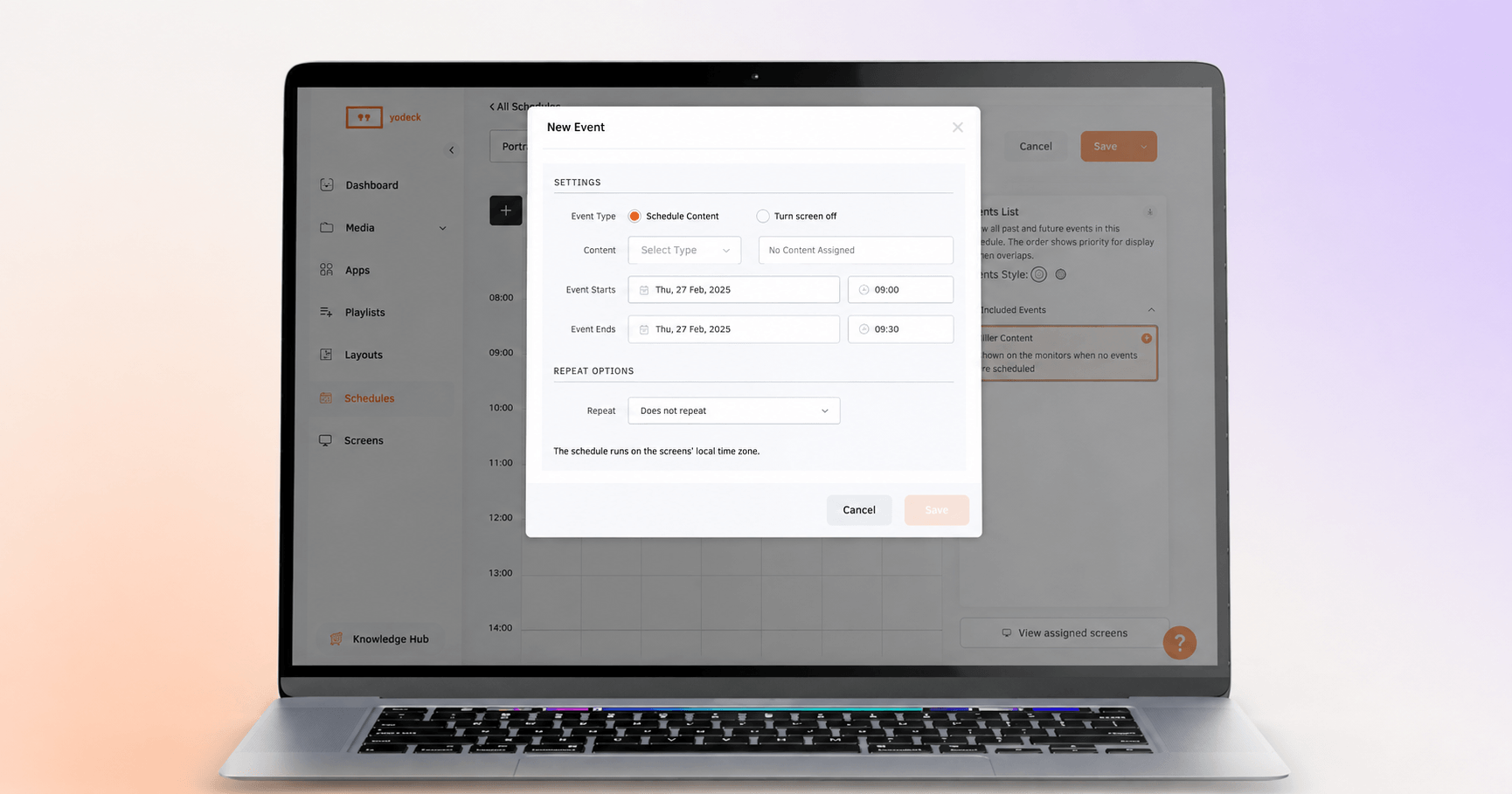
A price change at 9AM can be live on every screen by 9:01. Cloud-based digital signage separates the screen from the content, so whoever manages the message doesn’t need to be in the building, or in the same country. Sold out of an item? Pull it off the menu before the next customer orders it. Head office launching a campaign? It reaches all 40 locations at once, correctly, with no store manager taping up a poster from a courier envelope.
Pro tip by Yodeck Team: Scheduling turns real-time updates into automation. Set breakfast, lunch, and dinner content once, and the screens switch on their own every day. Time-specific content is where restaurants, gyms, and offices get the most daily value from their screens.
6. Screens make waiting feel shorter
Nobody has repealed the queue, but screens change how it feels. In “The Psychology of Waiting Lines,” David Maister established the principle that occupied time feels shorter than unoccupied time. A screen showing news, menu content, or practical information gives waiting customers somewhere to put their attention, which lowers frustration in checkout lines, lobbies, and waiting rooms. In healthcare settings the effect matters twice: an informed patient is a calmer patient, and a calmer waiting room is easier on staff too.
7. Digital signage reaches employees email can’t
Internal communication has a reach problem. Gallup’s State of the Global Workplace research puts global employee engagement at just 21%, and the employees hardest to reach are the ones without a desk: warehouse teams, retail floors, production lines, drivers. Email doesn’t reach a forklift. Digital signage for internal communications puts company updates, KPIs, safety records, and recognition where deskless teams actually spend their shift.
Swissport, the world’s largest aviation ground services provider, uses Yodeck screens across 300+ airports to reach 60,000 employees, most of whom work nowhere near a computer. Safety messages and operational updates reach ramp agents and baggage handlers on the floor, in real time, without depending on an inbox no one checks mid-shift.
8. Centralized screens keep branding consistent everywhere
Ten locations means ten interpretations of your brand, unless the content comes from one place. With centralized control, head office decides what plays everywhere, while local managers adjust only what’s genuinely local: their promotions, their language, their opening hours. Customers get the same brand in every store, and marketing stops discovering last year’s campaign still hanging in a branch six months later.
9. Digital signage broadcasts emergency alerts instantly
In an emergency, screens become the fastest channel in the building. Digital signage can override all scheduled content at once to show evacuation routes, lockdown instructions, or severe weather warnings, on every display, the moment it matters. Printed evacuation maps stay static by definition. A screen can tell people which exits are safe right now. For schools, factories, and any large facility, emergency override alone often justifies the system.
10. Digital signage measures its own performance
A printed poster can’t tell you if anyone saw it. Digital signage keeps records: what played, on which screen, at what time. Pair proof-of-play data with sales by location and you can answer questions print never could. Did the lunch promo screens correlate with lunch sales? Does the entrance display drive more redemptions than the checkout one? You can test two versions of a promotion in two locations and keep the winner, which turns signage from a fixed cost into a channel you can improve.
Digital signage benefits statistics
Most digital signage statistics circulating online trace back through chains of blog posts to studies no one links. The table below keeps only figures with a named, checkable source, each linked where it first appears in this article.
| Statistic | What it means for you | Source |
|---|---|---|
| 76% of consumers entered a store they’d never visited because of its signage | Signage is a customer acquisition channel, not decoration | FedEx “What’s Your Sign?” survey |
| 68% purchased a product because a sign caught their eye | Signs don’t just attract visits, they convert them | FedEx “What’s Your Sign?” survey |
| At least two-thirds of buying decisions are made in-store | The point of sale is where influence pays off most | Peer-reviewed shopper marketing research |
| 21% of employees globally are engaged at work | Internal communication has enormous room to improve | Gallup, State of the Global Workplace |
| The digital signage market will grow from $31.1B in 2025 to $58.4B by 2033 | Businesses keep voting for screens with their budgets | Grand View Research |
Interesting insight: Many widely quoted signage statistics, like the famous “83% recall rate,” come from studies conducted over a decade ago and are now nearly impossible to verify at the source. We left them out deliberately. If a number can’t be traced, it can’t support your business case.
Digital signage benefits by industry
The core benefits stay the same everywhere; what changes is which one carries the business case.
- Restaurants run digital menu boards for dayparting and upselling: breakfast switches to lunch automatically, and high-margin items get the most screen space at peak hours.
- Retail stores use screens for window displays that pull passersby inside and point-of-sale promotions that lift basket size. Retail digital signage earns its keep where foot traffic and margins meet.
- Offices put dashboards, KPIs, and company news on shared screens, keeping hybrid teams aligned without another all-staff email.
- Schools and universities rely on screens for campus announcements, schedules, and emergency alerts that reach students who will never open the newsletter.
- Manufacturing sites display production KPIs, shift schedules, and safety records on the floor, where the workforce is 100% deskless and safety metrics belong in plain sight.
- Healthcare facilities use waiting room screens for wait time updates and health information, keeping patients informed and calmer during unavoidable delays.
What are the advantages and disadvantages of digital signage?
Digital signage wins on flexibility, engagement, and long-term cost, while static signage wins on upfront price and simplicity. The honest comparison:
| Aspect | Static signage | Digital signage |
|---|---|---|
| Upfront cost | Low | Higher (screen, player, setup) |
| Cost per update | Full reprint every time | Zero |
| Content | One fixed message | Unlimited, scheduled, real-time |
| Attention | Fades after first viewing | Renewed by motion and change |
| Emergency use | None | Instant override on all screens |
| Measurement | None | Proof-of-play and screen-level data |
| Power use | None | Continuous draw while running |
The disadvantages deserve straight answers rather than a footnote. The upfront cost is real, though it has fallen sharply: a signage player now costs less than a mid-range office chair, and entry-level plans start free.
Content upkeep is the trade-off most buyers underestimate, since a screen showing stale content is a printed poster with a power bill; free digital signage templates and scheduled playlists cut that workload to minutes a week. Power draw is continuous while screens run, which is why Yodeck’s Working Hours feature turns screens off automatically outside business hours instead of letting them run overnight.
Is digital signage profitable?
For most businesses that update signs more than a few times a year, yes. The math has two sides. On the cost side, you stop paying for the print cycle and start paying for hardware once plus a subscription. Digital signage costs break down into a screen you may already own, a media player, and software that starts at free for a single screen. On the return side, the revenue benefits stack: point-of-sale influence, upselling, foot traffic, and the labor hours nobody spends swapping posters anymore.
The break-even question is really a frequency question. A sign that never changes should stay printed. A sign that changes weekly pays for its digital replacement quickly, and this is exactly how small businesses use digital signage to increase sales: one screen, one player, and promotions that change with the day instead of the quarter. Yodeck’s free plan covers one screen with no credit card, which makes the profitability question testable for the price of a media player.
Why is digital signage important?
Digital signage matters because attention has become the scarcest resource in every physical space, and screens are winning it. The market numbers reflect that shift: Grand View Research values the global digital signage market at $31.1 billion in 2025, projected to reach $58.4 billion by 2033 at an 8.2% annual growth rate. That growth is businesses across every industry concluding that a message which can change beats a message that can’t.
The importance compounds as customer expectations shift. People now expect real-time information everywhere: live wait times, current prices, today’s schedule. A printed sign can’t meet that expectation. A screen does it by default.
Getting started with digital signage
The barrier to entry is lower than most first-time buyers expect. Digital signage software like Yodeck runs on a cloud dashboard: sign up, plug a media player into any screen, and manage everything remotely from day one. Yodeck holds a 4.7 out of 5 rating across 3,000+ verified reviews on G2, where reviewers most often mention ease of use and easy setup, and G2 recognized Yodeck as a Leader with 20 Spring 2026 badges. The free plan covers one screen, so you can test every benefit in this article before spending anything on software.
Digital signage pays off the same way it works: continuously. Every benefit above, from point-of-sale influence to internal reach, comes from the same screens and the same subscription, which is why the business case rarely rests on one benefit alone. Start with one screen for free and let the results argue for the rest.
Still reprinting signs?
Try Yodeck’s award-winning digital signage solutions and update every screen from one dashboard.
Start for free